


In April 2024, eighteen scientists convened in Pasadena for the first terraforming workshop in over thirty years. Revisiting the feasibility of terraforming Mars in light of modern technology is sorely needed. Since the early 1990s, Starship, synthetic biology, and planetary science have upended what we know about Mars and its future. The Mars of The Martian and the Mars Trilogy belongs to an earlier era, and today’s science offers a very different view of how the planet might someday be made to bloom.
The 2024 workshop subtitle was, “Is terraforming Mars feasible? How could it be done, and what might change our minds?” Much of the workshop was dedicated to working sessions where attendees did order-of-magnitude calculations, identified key technical unknowns, and began assembling the first integrated picture of how terraforming might be achieved using current technologies. By the end of the workshop, a new concept for how to terraform Mars had emerged — one that might actually work.
Subscribe nowHow to terraform Mars
So how do you do it? We recently hosted the 2025 Green Mars workshop, and to quickly bring attendees up to speed on where we left off last time, we created the Introduction to Mars Terraforming, 2025 Workshop Summary. This document presents one option for how Mars could be terraformed. It tells the story of how it could be done backwards, beginning with a possible feasible end state and working backwards to how it could be accomplished.
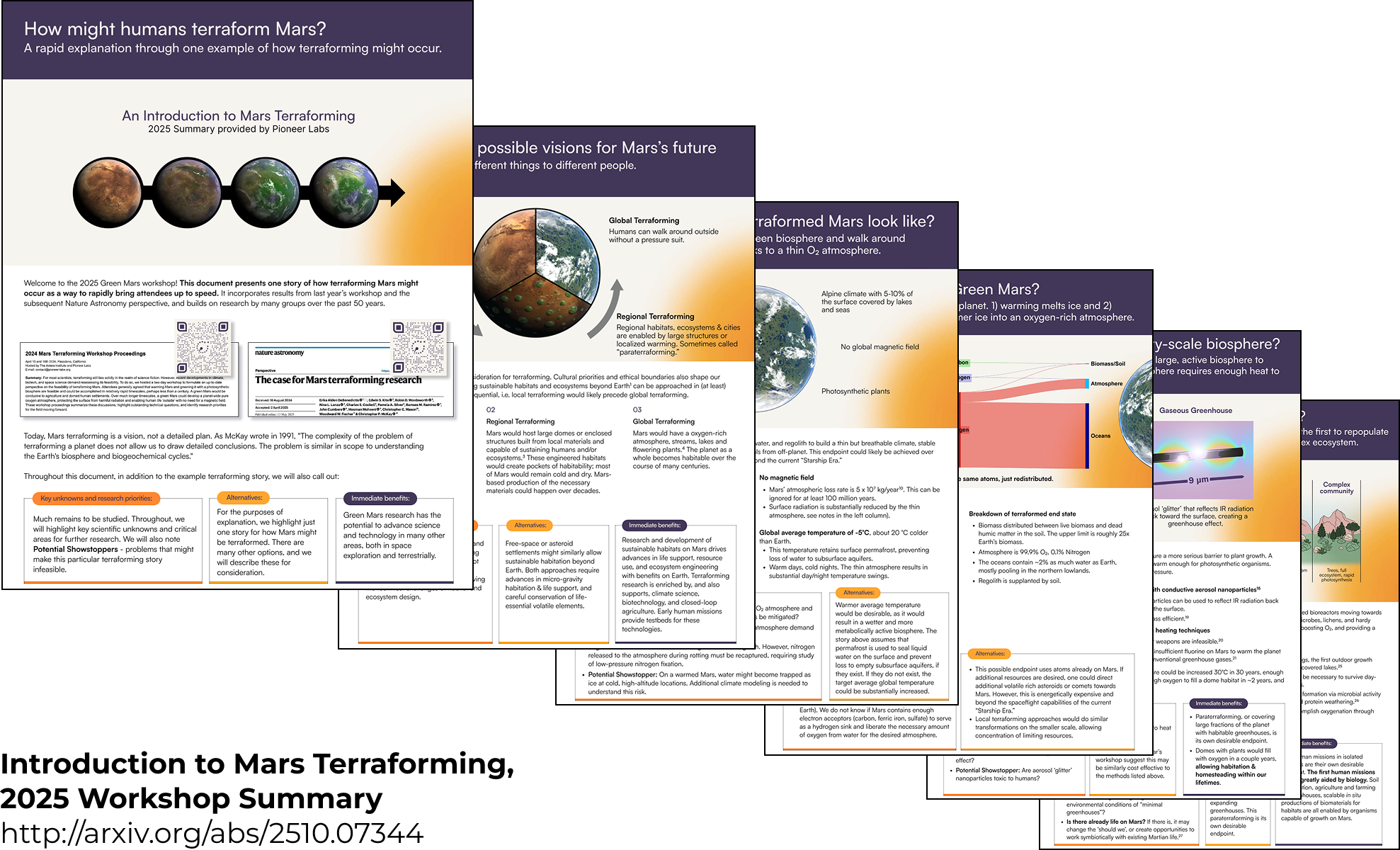
What’s cool about the story told here is that it is consistent with everything we know today about Mars. And the news is good! We think that Mars could be green in our lifetime, but you’d still need an oxygen mask. Yet, many questions remain, and the above document calls out the key scientific unknowns, research priorities, and proposed alternatives.
We think that Mars could be green in our lifetime, but you’d still need an oxygen mask.
Rethinking terraforming in the Starship era
Earlier visions of terraforming imagined an Earth-like endstate warmed by greenhouse gases, with a thick atmosphere and an artificial magnetic field. Now that we have more data about the realities of Mars and substantially improved spaceflight capabilities, we can make more detailed proposals for terraforming Mars in today's Starship era.
What, specifically, is different?
A Green Mars is likely to have a thin atmosphere and alpine climate. Our summary envisions a breathable, oxygen-rich atmosphere at ~150 mbar O₂, which can be generated entirely from resources already on Mars. This is not an Earth clone, but rather a thin, life-supporting envelope that still exhibits large day-to-night temperature swings but blocks most radiation. Such a state would allow people to live outside on the planet’s surface. Unlike previous terraforming ideas, this endstate might be quite doable with our current spacefaring capabilities and technology: you don’t need to crash asteroids into Mars, nuke the ice cap, or create an artificial magnetic field!
Heating can be relatively fast; oxygenation cannot. Several approaches (aerosol IR-scattering “glitter,” distributed solar reflectors, and solid-state greenhouses based on transparent insulating materials) could raise global or regional temperatures on a timescale of decades. However, building up oxygen in the atmosphere biologically is a slow process, and order-of-magnitude estimates suggest that it would take millennia for planetary oxygenation under conservative productivity assumptions. However, large local domes could be oxygenated within a few years. That means that within our lifetimes, we could have a green planet, covered in a thriving, global biosphere, where ‘homesteading’ of domed human habitats can happen on human timescales.
Leave a commentCritical unknowns might be showstoppers. A short list of unknowns deserves special emphasis:
Water sinks. On a warmed Mars, water might become trapped as ice at cold, high-altitude locations or in aquifers. Additional climate modeling is needed to understand this risk.
Redox capacity of the crust. Oxygenation requires a sink for hydrogen; if Mars’ crust lacks sufficient electron acceptors (inorganic carbon, ferric iron, sulfate) to bind liberated hydrogen, atmospheric O₂ could be limited regardless of biological productivity. This is a geochemical constraint with considerable implications for the feasibility of making Mars green.
Regolith chemistry and toxicity. Perchlorates and high salinity are real practical constraints on early biological steps. Understanding the spatial variability of nitrates and other bioavailable elements, data currently available from only a few sites, is essential before proposing large-scale biological interventions.
Human health and engineering risks. The long-term health impacts of high O₂ partial pressures, aerosol toxicity, and radiation effects under the proposed engineered atmosphere require serious study before humans could walk around on the surface for long periods.
Within our lifetimes, Mars could be a green planet, covered in a thriving, global biosphere, where ‘homesteading’ of domed human habitats can happen on human timescales.
A new discipline in formation
The Introduction to Mars Terraforming, 2025 Workshop Summary is explicitly framed as one possible story for how to make Mars Green, not a definitive plan or the only option. It is anchored in the data, but acknowledges many of the potential alternatives and unknowns that might be “showstoppers.” This is an intentional signal that this narrative should be critiqued and revised upon the acquisition of new data.
A striking moment from the workshop occurred when we presented this introduction, sparking a lively debate about carbon dioxide outgassing from Martian regolith. That discussion revealed new and relevant details we hadn’t fully considered, and it’s a great example of the kind of challenge and refinement we’re looking for. This kind of exchange is how a field matures, and we look forward to capturing these insights in the workshop proceedings and translating them into a more detailed research roadmap.
Taken together, these workshops and the accompanying documents transform terraforming from a handful of disparate papers across disciplines into a multidisciplinary research field.
The field grows
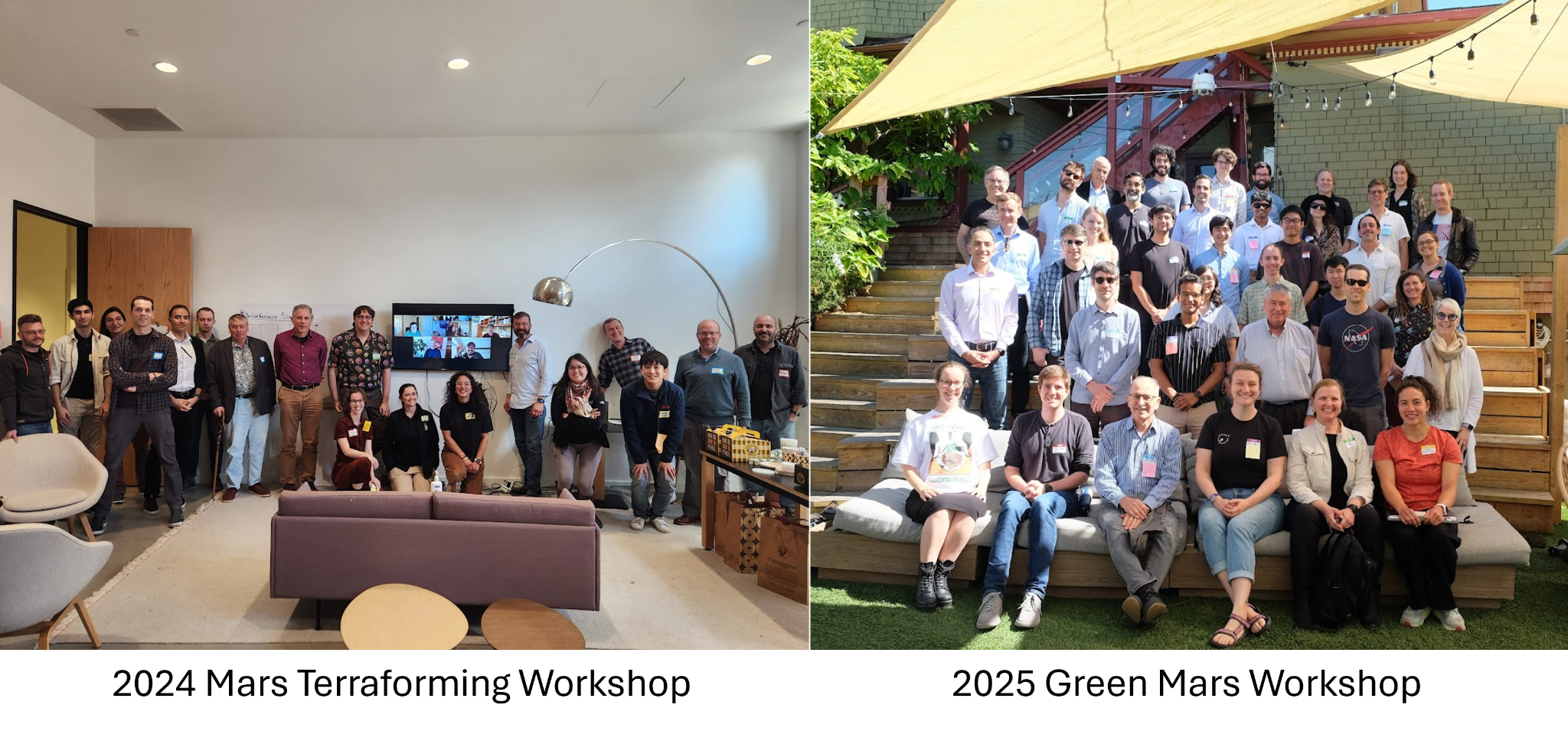
In the past year and a half, this area of research has gained momentum. The 2024 Workshop Proceedings were released, followed by an opinion piece in Nature Astronomy that advocates for serious study of the topic. Multiple attendees of the 2024 workshop published significant research in the past year, including new proposals to easily warm Mars with aerosol nanoparticles and create self-scaling organically generated habitats.
The 2025 workshop had twice as many attendees as the 2024 workshop. The number of scientists working on terraforming projects has roughly 5x’d since the last workshop, in large part thanks to funding from the Astera Institute. As our colleague Edwin Kite put it, “the field went from non-existent to tiny.” This year’s workshop included a larger group of planetary scientists, biologists, engineers, and funders to take stock of what we know and sketch a research roadmap that will take terraforming research through the next step change: from tiny to small.
Shared curiosity
Ethics and policy surfaced repeatedly at the workshop. The question “should we?” remains both vital and unresolved. However, many technical goals are shared regardless of one’s philosophical stance. Whether the desired endpoint for humanity’s interaction with Mars is limited (crewed local research outposts), intermediate (paraterraforming via large greenhouses), or global (planet-scale warming & oxygenation), the early science and technology needs are substantially overlapping. In all cases, we need better climate models, robust ISRU for habitats made from local materials, validated biological tolerance limits, and de-risking of essential hardware with flight tests.
Benefits abound closer to home as well. Other participants emphasized the near-term, non-terraforming payoffs: climate modeling, closed-loop life support, and low-resource biomanufacturing have immediate terrestrial benefits. Even if global Mars terraforming is never pursued, the work strengthens Earth science and technologies for remote, resource-constrained environments. This shared upside helps justify collaboration across philosophical lines.
What comes next
We’re happy to share this document now, but more follow-ups from the workshop are pending:
Compile 2025 workshop proceedings that document the workshop’s technical findings and assumptions,
Create a research roadmap that prioritizes experiments and data collection (regolith surveys, atmospheric-escape modeling, aerosol toxicity tests, ISRU flight tests, cost and time estimates), and
Launch a grant program to catalyze work that can answer the high-value questions quickly.
Today, there are ten times more research questions than there are scientists to work on them, and that means there’s a high-leverage opportunity to use strategic thinking and funding to advance the field rapidly. Pioneer Labs is helping to coordinate these efforts and will publish the proceedings when they are ready. Stay tuned!
Do you have opinions?
We want to get feedback on our work faster than traditional scientific publishing will allow. That’s why we’re posting updates here. Please do comment below if you have thoughts on this post, and sign up to get future updates!
In particular, we would love to hear your thoughts on:
The Introduction to Mars Terraforming. We welcome critiques, suggested revisions, and additional showstoppers! We’d also love to hear if you can provide some more insight into any of those questions.
Suggestions for research projects to develop or de-risk critical technologies.
We’re hiring
Pioneer Labs is recruiting! We’re looking for a Lab Manager and an Operations Associate to join the team in late 2025. Check out our website to see open roles, apply by November 7th, sign up for alerts when new jobs are posted, and to learn more about our work. If you know someone who would be excited to join the team, please pass along these opportunities!


