

We regret to inform you that Green Mars may have an insect problem
An urgent end-state consideration for planetary engineering

🚨🪲 We forgot the bugs
In developing a roadmap for a green Mars, we considered climate, radiation, water, oxygen, and biology. We did not, until now, consider the maximum acceptable dimensions for a dragonfly.
In An Introduction to Mars Terraforming, we describe a low-pressure, oxygen-rich atmosphere of about 150 mBar that could support human life. Then we worked backward to the technologies and biological processes that might get us there. But we forgot to mention that such a high-oxygen environment might also support enormous insects, similar to the high oxygen atmosphere of the Carboniferous period on Earth.
This is an April Fools post, but it is only partly a joke. Mars is, first and foremost, too cold and dry for life.1 But once you start talking seriously about a living Mars, you need to consider a long tail of questions. Some of them are grand and philosophical, like the ethics of spreading life between planets. Others are much more specific, like whether a future Martian ecosystem comes with arthropods of alarming size.
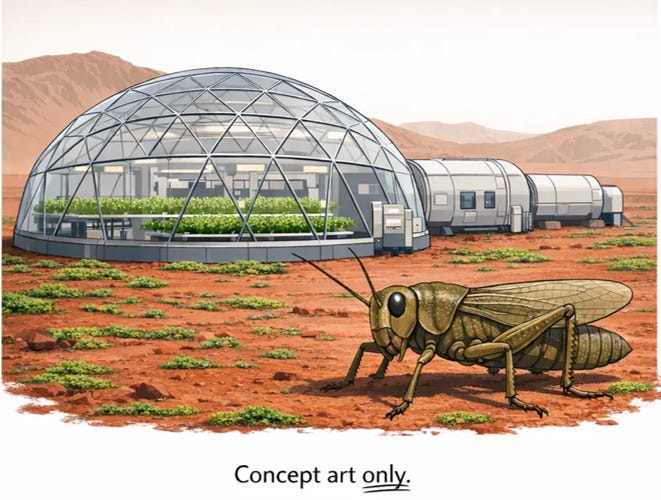
🫁🐞 Why the bugs might be massive
We know from the fossil record that giant insects once roamed the Earth, and it’s been proposed that the oxygen-rich atmosphere at the time helped make that possible. Insects breathe through a tracheal system rather than lungs, so oxygen delivery has long been discussed as one factor that could constrain body size.2 In Drosophila and other model systems, changing atmospheric oxygen changes body size and tracheal development.3
A lot of this is quite theoretical. There is probably not a simple slider where 21% oxygen gives normal flies and 50% gives monsters. But once you start proposing unusual oxygen atmospheres, weird insects become an annoyingly legitimate thing to think about. During high-oxygen periods, Earth hosted some arthropod scales that most modern readers would prefer remain firmly in the fossil record.
🔥🌬️ Mars is not Carboniferous Earth
Our proposed Green Mars is not just “ancient Earth, but on Mars.” The ancient earth atmosphere that supported big bugs was dense and warm, while a green Mars would be lower pressure, lower temperature and lower gravity. If Mars ever gets insects, they would take millions of years to fully adapt and would likely be strange in specifically Martian ways, not just oversized Earth ones. Think enormous wings to bite into the lower density atmosphere and multi-layer insulative shells to keep them warm through cold nights.
The more immediate atmosphere-design concern is not giant insects at all. It is fire. Oxygen-rich atmospheres can be breathable, but they also raise flammability, a lesson NASA learned tragically in the Apollo 1 fire. In its official investigation, NASA identified the high-pressure pure-oxygen cabin atmosphere as one of the major factors in the disaster.4 Our proposed Martian atmosphere is much lower-pressure, which should ameliorate the risks.5 But this is the broader lesson here: once you redesign an atmosphere, and certainly once you redesign a planet, you inherit second-order consequences whether you want them or not. Giant dragonflies are more fun to imagine, but fire safety is the more immediate engineering problem.
🌱🪐 Building a biosphere is complex
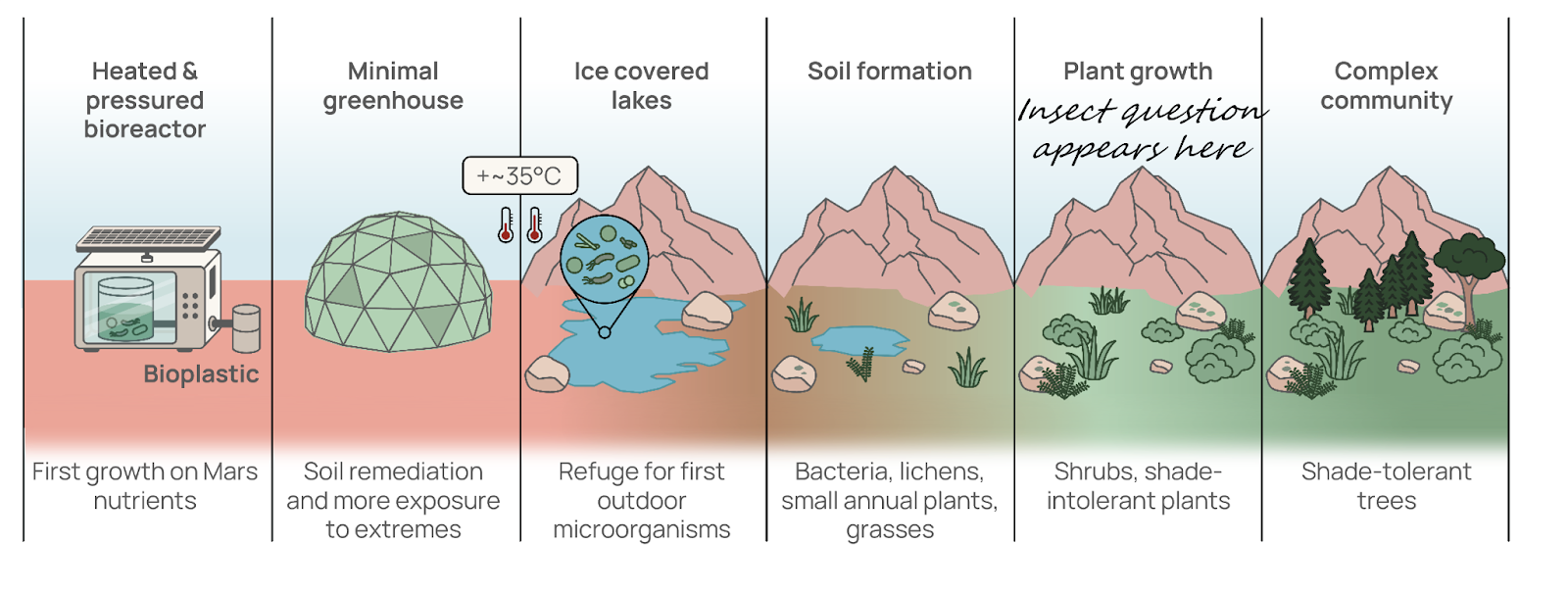
Those second-order consequences are really the point of this post. The insect question matters not because Mars is destined to be overrun by giant bugs, but because it illustrates the many ecological and engineering details in need of consideration. Our own work so far sits much earlier on that ladder. In How to make a microbe for Mars, A Biologist’s Guide to Mars Dirt, and Our first target microbe for Mars, we’ve focused on the first practical steps for Mars-ready microbes, useful regolith media, and indoor, infrastructure-heavy bioprocesses.
As recent work on Mars terraforming emphasizes,6 the first problems are still planetary: warming enough for liquid water, enabling oxygenic photosynthesis, dealing with CO₂ availability, water and ice behavior, oxygen buildup, crustal redox capacity, and the sheer industrial scale required to change a planet. Big bugs are a convenient ambassador for the broader weirdness of all of the ways in which a Green Mars would not be Earth-but-less-blue. And some of its consequences will sound like jokes right up until they need a research program.
🔬🦠 Real things we’re actually working on
To be completely clear: we are not currently engineering Martian dragonflies. If you’re curious about what we’re actually doing, keep your eyes peeled for upcoming technical reports on:
A technique for whole-genome saturating mutagenesis
How to fully simulate soluble Mars soil chemistry in a lab
The first microbes we engineered for better growth on Mars
Open source lab automation and how we use it
As well as a roadmap for Pioneer’s next year of research!
Thanks to Niko McCarty for providing input on this piece!
For more information see both An Introduction to Mars Terraforming & The case for Mars terraforming research
The link between higher oxygen and bug body size is still theoretical, though there are multiple mechanisms in support of the idea. Atmospheric oxygen level and the evolution of insect body size
The trachea diameter of flies changes dramatically as the oxygen concentration does! Plastic and evolved responses of larval tracheae and mass to varying atmospheric oxygen content in Drosophila melanogaster
At the time of the Apollo 1 fire, the cabin atmosphere was 100% oxygen at about 1.13 atmospheres, about far above normal Earth oxygen partial pressure. NASA’s Apollo 204 Review Board is the definitive source on this.
For an initial source, see the NASA encyclopedia on internal atmospheres. Note also that Apollo 7 used 345 mbar pure oxygen for 10 days. Still, the overall flammability of hydrocarbon-derived materials increases at high oxygen concentrations.
For an excellent skeptical review of the difficulties of Mars terraforming, see Terraforming Mars: Mass, Forcing, and Industrial Throughput Constraints
It is pretty mind-bending to wrap your head around the implications of a mostly oxygen, lower pressure atmosphere. It does seem to work! We don’t really need the nitrogen anyway. But lots of edge cases like this to think through 😂