

BioBloom: Bringing Scanning Mutagenesis to Whole Genomes
Millions of mutations, one experiment — and the libraries are public

At Pioneer, we are developing organisms and bioprocesses for Mars. In our earlier post, we said that life from Earth might adapt to Mars on its own if given the chance, but it would likely take millions of years. Thus, we use some forms of souped-up evolution in the lab to explore, accelerate, and direct progress, getting this to happen a lot faster, and teach us some things along the way. At Pioneer we ask “How can evolution be faster, easier, and produce better data?”
We’re excited to share a new technical report detailing an approach we’ve developed at Pioneer that we call BioBloom, a method for Barcoded Saturating Mutagenesis of an entire bacterial genome. BioBloom creates a tube of bacteria in which every possible single-base mutation to a genome is explored, and each bacterium carries a little DNA name tag (or “barcode”) labelling which mutation they are trying out. This tests a broader and more complete set of mutations than classic approaches where bacteria evolve the old-fashioned way, and allows us to measure the relative growth of millions of different mutants simultaneously with DNA sequencing. Altogether, BioBloom produces datasets where we’ve given every single mutation to a bacterial genome a shot, and measured whether it helps a strain grow in a new environment, and by how much.
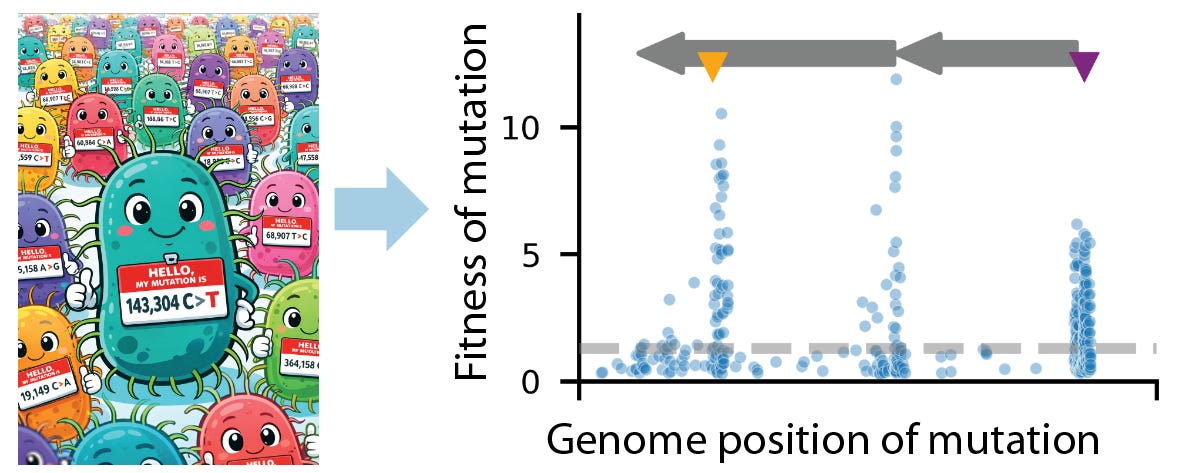
Every genome sits in a vast space of possible variations, and BioBloom systematically maps all single steps in that vast space of variation, defining where the roads are, and where they appear to lead. The example above is a small slice of the data we obtained from growth in salty broth, showing two genes where mutations improved salt tolerance. The most successful mutations are clustered around catalytic sites and regulatory motifs, marked with orange and purple arrows.
To learn more, you can read our technical report on BioBloom, and its open peer reviews. If you want the actual E.coli libraries, you can get them from Addgene as a kit. Here we’ll take a bigger-picture view of why we created this technique and where we think it could be headed in the future.
Domesticating microbes, faster
BioBloom can help us adapt microbes to new tasks and environments faster than existing approaches because we don’t have to wait for mutations to occur or for one to “win”. This is important and timely for biotechnology, with microbes being used today to turn CO2 into food, replace fertilizer for crops, digest waste into renewable energy, mine precious metals, remediate toxic waste, and countless other goals.
In all these applications, we’re “domesticating” previously wild microbes. We give them tasks within their latent abilities, but with unfamiliar temperature, conditions, community, nutrients, environment, and we ask them to do their new job fast. Humankind has domesticated countless different plants and animals, painstakingly stumbling upon variation, curating variants, and breeding them over thousands of years. Microbes are too small to see, which makes it harder. We can pick out a corn ancestor that matures at the right time or produces more grain, but it’s difficult to pick out a bacterium that’s doing unusually well from a big fermentor, the roots under a field of crops, or a copper mine.
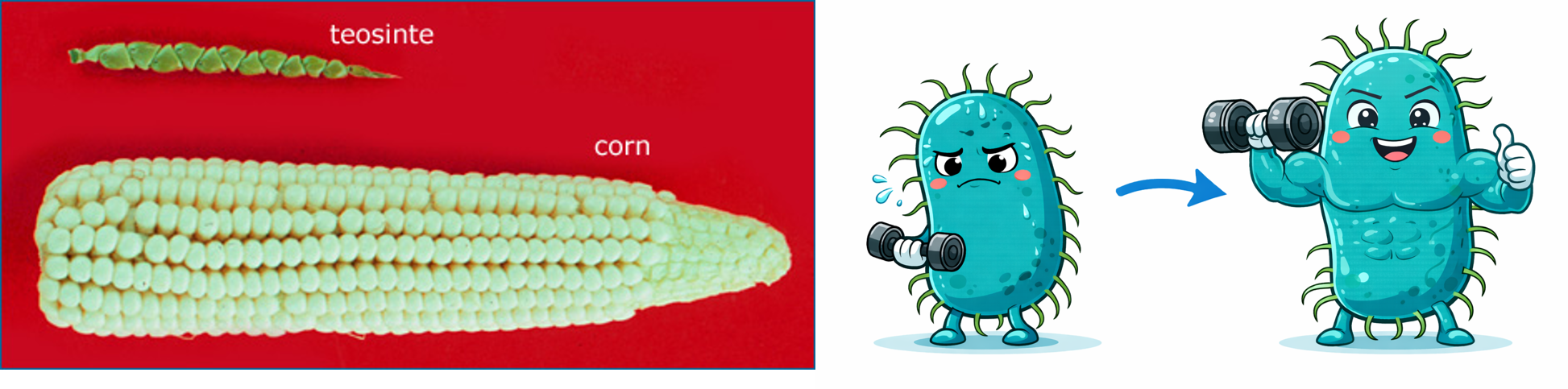
BioBloom helps explore and detect these elusive improvements to domesticate microbes faster, and pick the best microbe more often. By creating nearly all single mutations in a bacterial genome, we no longer have to wait for mutations to arise. DNA nametags allow us to quickly determine who in that pool of trillions of cells is doing well in this new environment, and by how much. Where existing approaches like Adaptive Laboratory Evolution (ALE) have succeeded at lab scale, they often have to wait for specific mutants to take over the whole culture before they become detectable. This is not practical for many scaled applications. There is also no guarantee that you end up with the best mutation, as random mutations occur over time, so a middling mutation that occurs first can easily win. BioBloom avoids many of these pitfalls and could be applied to improve microbes for all kinds of scaled applications, exposing the juiciest improved mutations rather than leaving it to chance.
A Depth of Data
But there’s more to this data than just picking the winners. The millions of measurements in a BioBloom dataset also tell you something about how the genome of the bacterium works, what’s in it, and how this microbe could be performing the given task better. This kind of data has been available for proteins for some time now, and “saturating mutagenesis” data has paid dividends: identifying important regions, clarifying enzyme mechanisms, and even uncovering entire unknown genes hidden inside others. Extending this approach from one gene to an entire genome extends these kinds of insights to whole cells. It uncovers components of the bacterial genome and important mechanisms we didn’t know existed. Better yet, it very concretely shows how they can be improved for a specific environment.
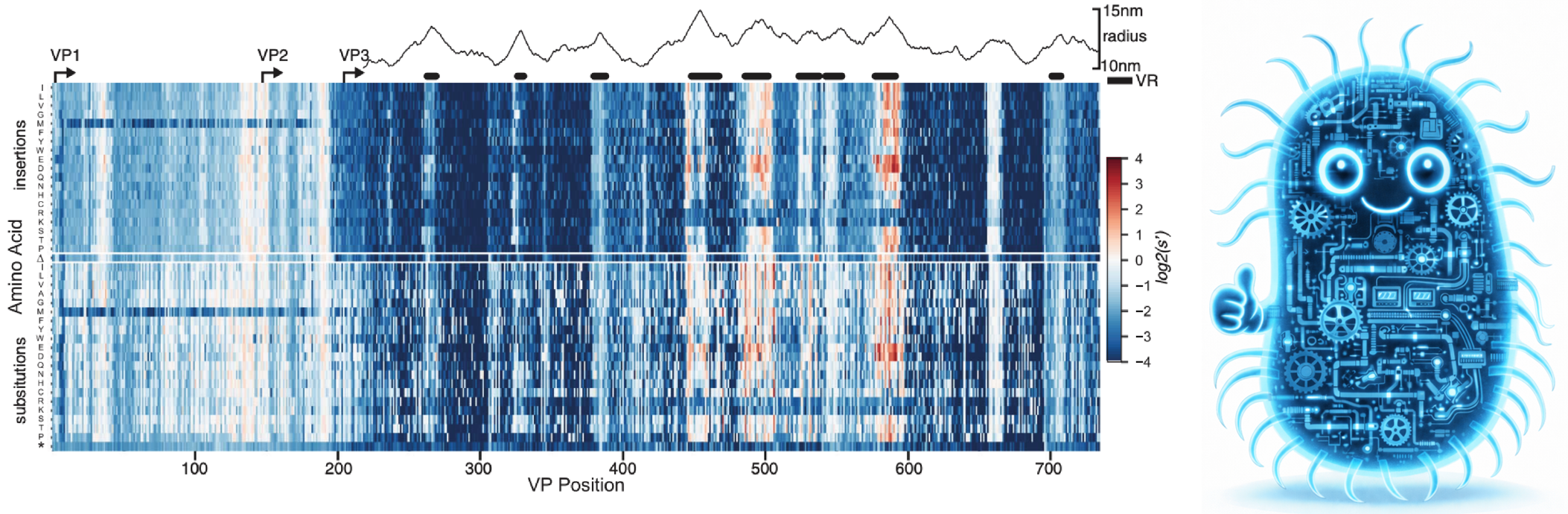
Saturation mutagenesis datasets for single proteins have been used to train AI models, and these models are successful at improving proteins- with this “labeled” data from experiments significantly outperforming models trained only on “unlabeled” data- sequences alone. At the same time, we are seeing some of the first AI models applied at the whole genome scale. Whole-genome datasets like Tn-Seq have been used to train AI models to improve understanding and improve synthetic designs. There are some unknowns when bridging this gap, but we’re optimistic that BioBloom can help us model and generate dramatically improved strains.
The Future of BioBloom
We’ve made our BioBloom libraries in E. coli available publicly on Addgene (Kit 1000000273) so that other researchers can use them. We see this as a successful example of an FRO-style nonprofit research project: BioBloom required some up-front risk and cost that made it unlikely that any academic lab was going to create it, but it was speculative enough that industrial biotech was unlikely to try it either. Producing it at Pioneer and sharing it is a bit more evidence for the value that nonprofit research entities can provide.
We believe BioBloom might replace traditional, labor-intensive laboratory evolution for some applications, and help deconvolute the mutations that result from others. When combined with other techniques, BioBloom can chart a course for how to make drastic changes to our favorite synthetic biology workhorse, including Genome Recoding, integrating new metabolism for fixing CO2, using carbon-neutral feedstocks, or testing new-to-nature pathways altogether. Applying selection schemes like Biosensors or anti-nutrients to these libraries can more effectively target specific phenotypes for bio-production, rather than whole cell survival/growth. BioBloom could also be extended to study combinations of mutations, and some of the core technical requirements for this have been worked out.
E. coli is often where a new technique is proven first, but it should only be the beginning for BioBloom. The retron editing technology underlying BioBloom has been shown to work in other bacteria, so, with further development, the same approach can function across a broader set of organisms and be applied to a broader range of applications. We’d love to see BioBloom helping researchers understand which variants might help their strains perform in applied, scaled-up conditions, such as the production of food protein, replacing fertilizer, treating wastewater, mining precious metals, and remediating toxic waste. If you’re considering one of these projects or are interested in supporting any of them, reach out! We’d like to help make it happen.
For most of history, evolution was something that happened at its own pace. Every genetics textbook defines Forward Genetics as characterizing mutant organisms to understand their underlying genetics, and Reverse Genetics as making specific changes to see what happens. Now, with the ability to make almost any change we can imagine and read off their impact millions at a time, the distinction between forward and the reverse are blurred. BioBloom fully maps a single evolutionary jump, turning a blind search into a mapped landscape. And once you have the map, you can get a lot further!
By measuring how life adapts — to salt, to stress, to new chemistry, even to Mars — then we can begin to build organisms that help us take care of this planet, and maybe one day thrive on another.