

How do you simulate Mars on Earth?
An interview with Erika DeBenedictis

Thomas Kalil, CEO of Renaissance Philanthropy, interviews biological engineer Erika DeBenedictis, CEO of Pioneer Labs.
Pioneer Labs is a startup focused on engineering life to make Mars more habitable. Their work sits at the intersection of biological engineering and space science. They make the technology that will allow the first humans on Mars to live off the land rather than rely on supply chains from Earth.
Pioneer recently released a paper about how to simulate Mars on Earth based on rover data, and how to handle fundamental uncertainties about the chemistry of Mars.
I serve on Pioneer’s board and have watched this work develop over several years. I sat down with Erika DeBenedictis, Pioneer’s co-founder and CEO, to ask the questions I’d most want answered if I were encountering this work for the first time.
Tom: Why do we care about the dirt on Mars?
Erika: Dirt on Mars, or “regolith,” is one of the most abundant sources of useful materials we’ll need for robotic and human missions. Most of the key atoms that make up life are present in the dirt on Mars.
It’s important to know what’s in the dirt so we can figure out how to use those resources for everything from agriculture to mining. Mars is so far away from Earth that it’s essential for us to ‘live off the land’ and rely on local resources as much as possible. We just can’t bring everything with us.
Tom: How do we know what’s in the dirt on Mars?
Erika: No one has ever brought Mars dirt back to Earth to measure what’s in it! This makes it difficult.
However, Mars rovers have taken some very nice chemical measurements of the dirt, so what’s there is not a complete mystery. We can also look at the chemistry of Martian meteorites that have landed on Earth and the chemistry of rocks on Earth that look similar to Martian rocks, on a mineralogical level.
Tom: You just released a paper, what was it about?
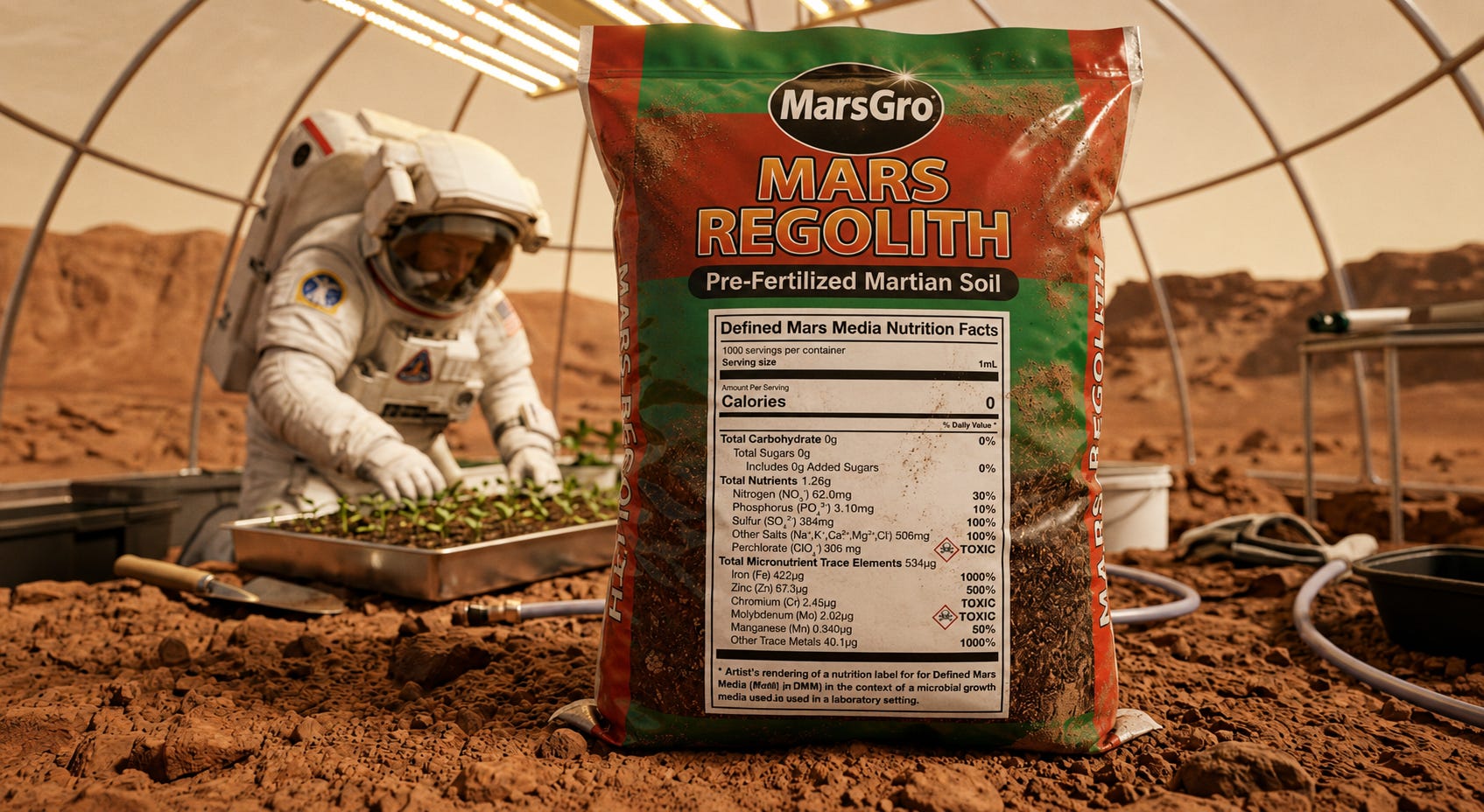
Erika: We just released a paper that explains how to simulate the biology-relevant chemistry of Mars dirt in the lab on Earth. We call the recipe “Defined Mars Media”, and it’s designed to accurately simulate the chemical composition of adding a ~tablespoon of Mars dirt to a ~liter of water, and whether it has all the chemical essentials necessary to support life. You can think of Defined Mars Media as a “nutrition label” for Mars dirt.
Tom: So what’s in the dirt?
Erika: It turns out Mars dirt is actually full of nutrients! Phosphorus and nitrogen are both present and abundant. But it’s also full of potential toxins, like salt and perchlorate. Perchlorate is particularly interesting - it is chemically a bit like bleach, which you probably use in your house to sterilize things because it’s good at killing stuff!
The challenge is finding organisms that can make use of the nutrients while tolerating the toxins.
Tom: Could Earth organisms grow on Mars?
Erika: Yes, but with limits. It’s extremely unlikely that anything could grow by itself outside on Mars - the environment is just too extreme. But perhaps organisms can grow with a bit of help from humans.
In this paper, we show that some Earth microbes can entirely source their nutrients from our simulated Martian dirt when you grow them in a stirred, heated container. For example, C. necator, a classic soil bacteria, could grow using the nutrients in Mars dirt directly. It wasn’t obvious if that would be true! It’s very cool, and good news for space exploration!
But only some Earth organisms work. Some can’t tolerate the toxins in Mars dirt, so X. autotrophicus is out. Some can’t use the type of nitrogen Mars dirt provides, so E. coli is out. Some require fancy vitamins that aren’t present in Mars dirt, so D. radiodurans is out. All of these organisms may come into play later, but they can’t be the first thing to touch the dirt on Mars.
Tom: So… could you grow a potato?
Erika: Ha! You might be able to grow a potato, but the potato would kill you!
In The Martian, Mark Watney famously stays alive by growing potatoes on Mars. But in real life it doesn’t work. It all goes back to those perchlorates I mentioned. If you actually grew a potato in martian dirt, the amount of perchlorate on the potato would poison your thyroid.
Agriculture is probably possible on Mars, but you need to remediate the toxins first, and add a lot of organic matter. We’re currently engineering microbes that will help with this, stay tuned!
Tom: How certain are you that there is fixed nitrogen in Martian dirt?
Erika: This is a super important question to get right. Nitrogen is essential for growing plants, and this is why the fertilizers we use on Earth are mostly fixed nitrogen, which is nitrogen bonded to other atoms in a form biology can use more easily than nitrogen gas. Yes, there is definitely fixed nitrogen in the dirt on Mars. In fact, by Earth standards, Mars dirt is pre-fertilized!
Interestingly though, the scientific literature is a bit hard to parse on this topic. Here’s why it’s confusing. In 2008, the Phoenix Lander took the first (and so far only) measurements of the chemistry of Mars dirt when it’s mixed with water. They were trying to see if there’s fixed nitrogen in the dirt. Instead, to everyone’s surprise, they discovered perchlorate! A lot of it too: the sensor on Phoenix was so overwhelmed by the sheer amount of perchlorate that it couldn’t ‘see’ whether or not there was nitrogen. Folks took a second stab at measuring fixed nitrogen in 2015, when the Curiosity rover used a different sort of measurement, this time one that doesn’t get confused with perchlorate, to measure nitrogen in Mars dirt, and found it. Curiosity sampled several locations and types of dirt, confirming that fixed nitrogen is present and widespread.
Tom: Couldn’t the dirt be different in different places on Mars?
Erika: Yes, it’s likely the dirt is different in different locations across the planet.
The very top layer of the ground on Mars is covered in very, very fine dust. This dust is thought to be pretty homogenous across the planet thanks to constant dust storms. So the ‘fines’ are probably something you can rely on anywhere you go to be part of the dirt.
But under the dust are larger particles, and their composition may vary to a greater extent based on the local rocks and geology. Similarly, macroscale rocks may be even more varied. If we want to mine, say, iron we may want to find an area of Mars where that metal is more abundant in the rocks and dirt.
Tom: So how do we deal with site-to-site-variability in the dirt?
Erika: We fundamentally don’t know exactly how much dirt on Mars varies site-to-site. What we can do is just measure whether or not it would matter for growing things!
A big benefit of the ‘recipe’ we present in the paper is that you can easily test how variations in its composition impact growth of living things. We did experiments where we systematically varied the composition of the simulated dirt by increasing or decreasing each component by 10x or 100x. So far, it looks like microbial growth is probably pretty robust to fairly substantial variations in dirt composition on Mars, as long as you have at least some nitrogen and phosphorus present.
Studying this robustness is probably the biggest unlock of having a defined media, and the big contribution of the paper we released. Anyone can now run these robustness tests around specific Mars sites or specific components they’re interested in!
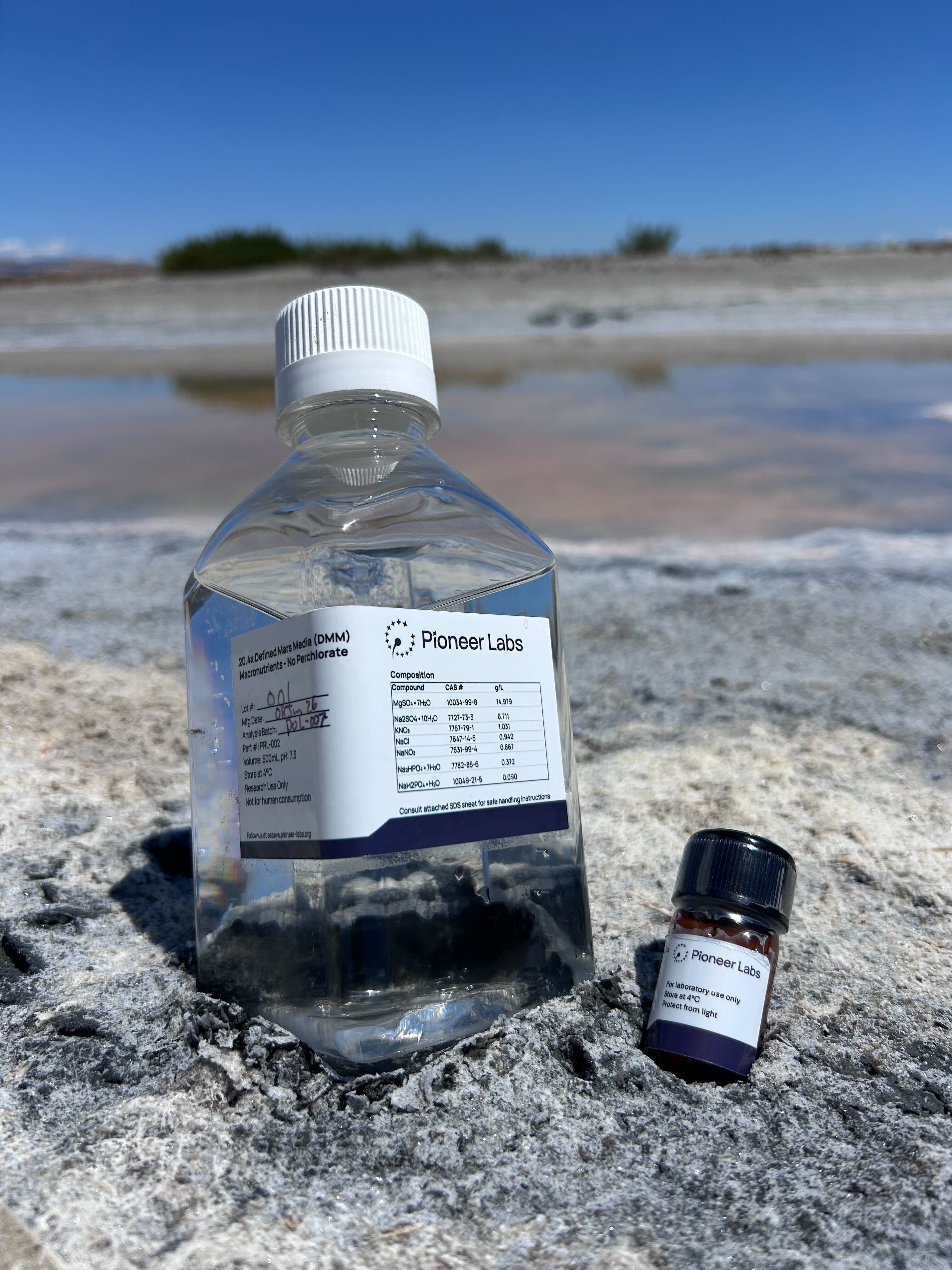
We want to make it really easy for people to replicate and expand this work. Scientists can buy the ‘standard’ recipe pre-mixed through Space Resources Technologies, just like you would buy any other standard growth medium in microbiology.
Tom: Space Resources Technologies sells other “Mars regolith simulants”. How are they different?
Erika: Indeed! SRT is probably the biggest provider of simulated Mars dirt to the space science community. Which simulant to use depends on what you need. If you need to buy a truckload of ‘Mars dirt’ to test your rover tires, SRT does the work of finding ‘similar’ Earth rocks, grinding them up to the right particle size, and doing logistics to send it to you. Those simulants are more designed to mimic the bulk properties of Mars dirt, like particle size, rather than the chemistry, which is what ours is designed to do.
Tom: Your recipe also provides a formulation of trace elements. What are trace elements and why are they important?
Erika: Biomass is mostly made of water, carbon, nitrogen, phosphorus, and sulfur. If you grind up any living thing and look at its atomic composition, that’s what you’d find.
But in addition, there’s a very long tail of trace elements that, depending on the organism, you might also need just a little bit of. We’re all fairly familiar with iron transporting oxygen in our blood. As another example, some organisms have specific enzymes that require a tiny amount of molybdenum to work. Those are ‘trace elements.’
We originally formulated Defined Mars Media with just the ‘macros’: nitrogen, phosphorus, and sulfur. You can do a lot of science just with this.
We then tried to use the defined media to do long-term adaptive evolution, and everything died after several weeks because the microbes were starved of trace elements! Some science will require that you add trace elements.
Tom: How did you come up with the trace elements in the recipe?
Erika: This was hard, since the rovers haven’t measured most trace elements. We know they’re there, but we don’t know how much there is. We thought about using a trace element mix off-the shelf, but those are designed to optimize microbial growth, which isn’t what we want.
So instead, we ended up measuring real rocks - from Earth - to create our formulation. They’re our best guess at what rocks on Mars are like. Yet, how similar Earth rocks are to Mars rocks is, of course, the fundamental question NASA’s planetary science division spends $2B/year studying. It’s the best we can do for now. Like many other researchers, we are eagerly awaiting more data from Mars rovers or, one day, actual dirt samples from Mars!
Tom: What’s next?
Erika: In this paper, we show that organisms can grow entirely using nutrients in the dirt, water, and air on Mars. And, with the right organism, growth can be robust to pretty substantial variations in dirt composition.
We have another report coming soon that goes a step further: once you can grow living things, what can you have them make? We’re using biology to convert dirt, water, and air into building materials. Stay tuned, the next report will be out soon!